Your team, your numbers, one room.
A private day with your own management team, run on your own P&L, your own POS exports and your own schedules. From $5,000 plus travel, priced after a short call and fixed before anything is booked.
It is for groups rather than individuals: the problem is usually not that one manager does not know how, it is that eleven of them each solved it differently and you find out at period end.
Run by someone who spent 8 years in restaurant operations, 6 of them leading ops across more than fifty stores. Not a technology consultant who read about restaurants.
Who this is actually for
Groups of roughly three to twenty locations, where somebody senior already suspects the answer is sitting in software they are paying for and nobody has time to go and find it.
The tell is usually consistency rather than capability. One store closes its period in an afternoon and another takes three days. One GM has built himself a spreadsheet that genuinely works and nobody else has seen it. Nobody is doing anything wrong, and none of it matches.
If you are a single independent restaurant, a seat at a public workshop is almost certainly the better buy, and I will say so on the call rather than sell you a day you do not need.
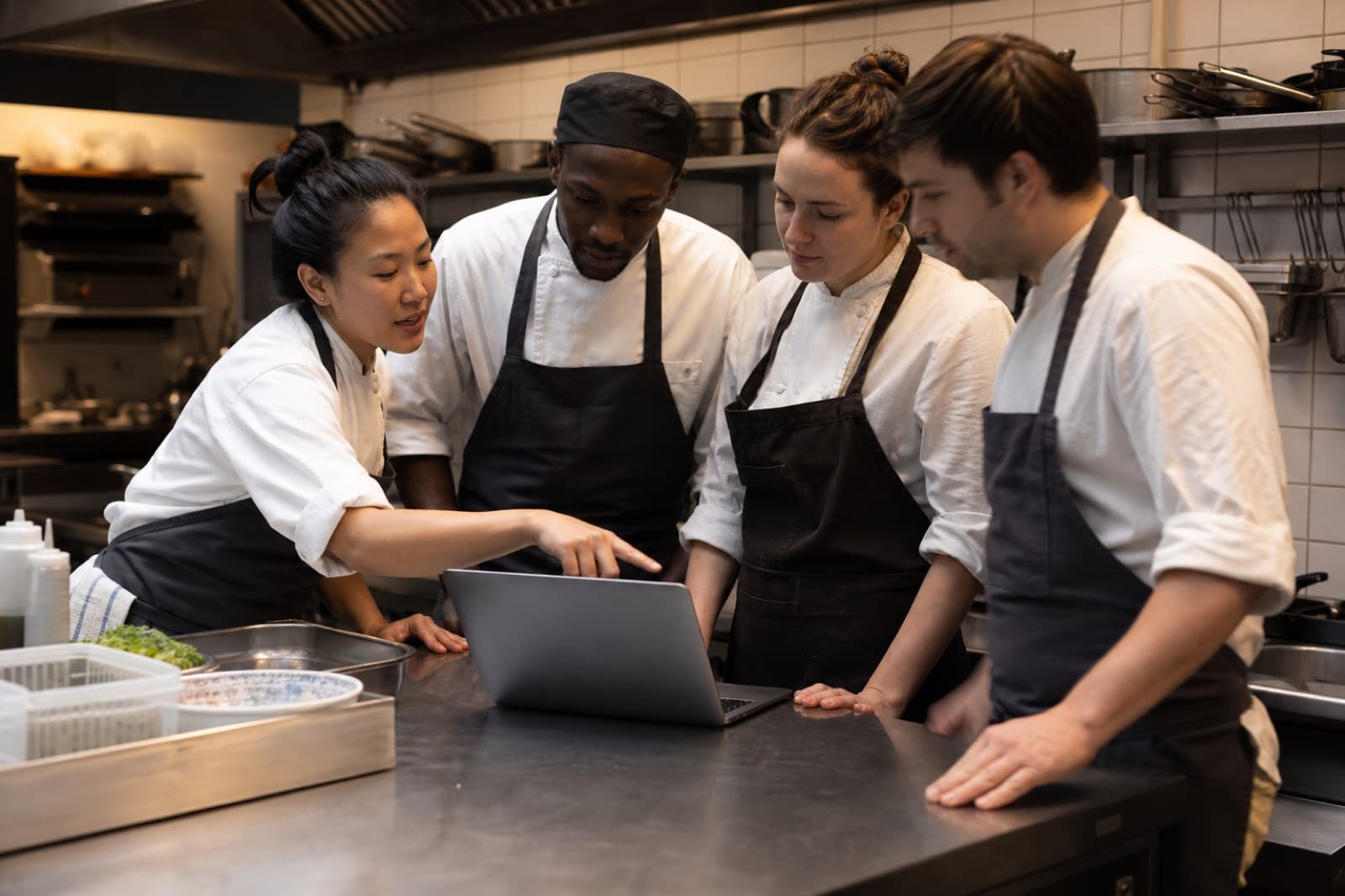
Your managers, in one room, on your own numbers rather than a demo set.
What a day looks like
The morning is what you already own. Almost every group is paying for more capability than anyone uses, spread across the POS, the scheduling tool and whatever the last vendor sold them. We go through it and write down what is actually there.
The middle is the work. Your managers take a real problem they have - the period-end report somebody rebuilds by hand, the prep list that lives in one chef’s head, the invoices being keyed in twice - and build the thing that handles it, on the day, with their own data.
The end is who owns what. A tool nobody is responsible for stops being used in about three weeks, so we finish by naming who runs each thing and what happens when it breaks.
What you get afterwards
Whatever your team built, working, plus a one-page printout for each thing. If a line cook cannot use it during a rush without thinking about it, it was built wrong.
What you do not get is a subscription. There is no platform here and nothing to log into afterwards. If you want something built properly after the day, that is separate work and separately priced, and plenty of groups never need it.
Written on this
- Managers are still doing this by hand
The Monday packet gets rebuilt out of three systems before anyone opens their mouth. That hour is assembly, not analysis, and it is the first hour I would take off a district manager.
- The Sunday night schedule is a tell
If your GMs still build next week in a spreadsheet after close, the scheduler you already pay for did not survive its first short week. What to fix, and why the GM still writes the schedule.
- Somebody is still keying invoices by hand
Retyping vendor invoices quietly costs a multi-store group hours every week. Do the arithmetic on your own numbers, get most of it back without buying anything, and keep a person on the part that matters.
More on working with a group
- What a private engagement costs
From $5,000, and exactly what moves the number.
- Rolling out across multiple locations
When every GM has invented their own version.
- Bring someone in, or use the person you have?
Including when the answer is your own spreadsheet guy.
- Implementation and building
When the answer is that somebody has to build it.
- Public workshops
The cheaper way in, if you have one or two to train.
Questions people actually ask
- What does a private engagement cost?
- From $5,000, plus travel. What moves it is how many locations, how many people, and whether you want the building afterwards or just the day. You get the number after a call, before anything is booked, and it does not change later.
- How is this different from buying seats at a public workshop?
- A public seat teaches one person on a shared session. A private day is your team only, on your own P&L, your own POS exports and your own schedules - so the examples are your problems rather than someone else's. If you have one or two people to train, buy seats. If you need a group to end up doing the same thing, this is the one.
- Do you come to us?
- Yes, nationally, and travel is billed separately and honestly. Plenty of groups do it remotely instead so their GMs join from their own stores without closing shifts. I will tell you which one your situation actually needs.
- How long does it take?
- A day is the usual shape. Some groups take a standing weekly session for a month instead, which is $1,750 and works better when the problem is habit rather than knowledge.
- What happens after the day?
- That is the part most training skips. Some groups need nothing. Some need the thing built, which I do separately. Some keep me on a call every few weeks while it beds in. None of that is bundled in by default, because charging you for support you do not need is how this turns into a subscription.
- Do we need to buy new software?
- Almost never, and I will tell you when the answer is yes rather than sell you something. Most groups already pay for more than their teams use, and finding that is usually the first part of the day.
- Will this replace anyone's job?
- No, and I would turn the work down if that were the point. What gets automated is the paperwork nobody wanted, so your managers are on the floor instead of in the office.
Still deciding?
Take the free check first. Eight questions, no email, and you get the two things I’d fix in your building before I ask you for anything.